There’s picky eating, and then there’s watching your dog turn down practically everything you put in front of her for weeks on end. I thought I knew picky. Freya has always had some strong opinions about food. She likes what she likes, and sometimes she suddenly doesn’t like what she liked yesterday.
Then she developed heart disease and started taking multiple medications, and I learned what a dog with almost no appetite actually looks like.
For a while, feeding her became one of the most stressful parts of my day. Something she happily ate yesterday could be completely unacceptable today. She might eat from my hand but not her bowl. I’d finally find something she at least sort of liked (like lean burger patties), buy more of it, and discover that Freya’s relationship with that particular food had apparently ended overnight.
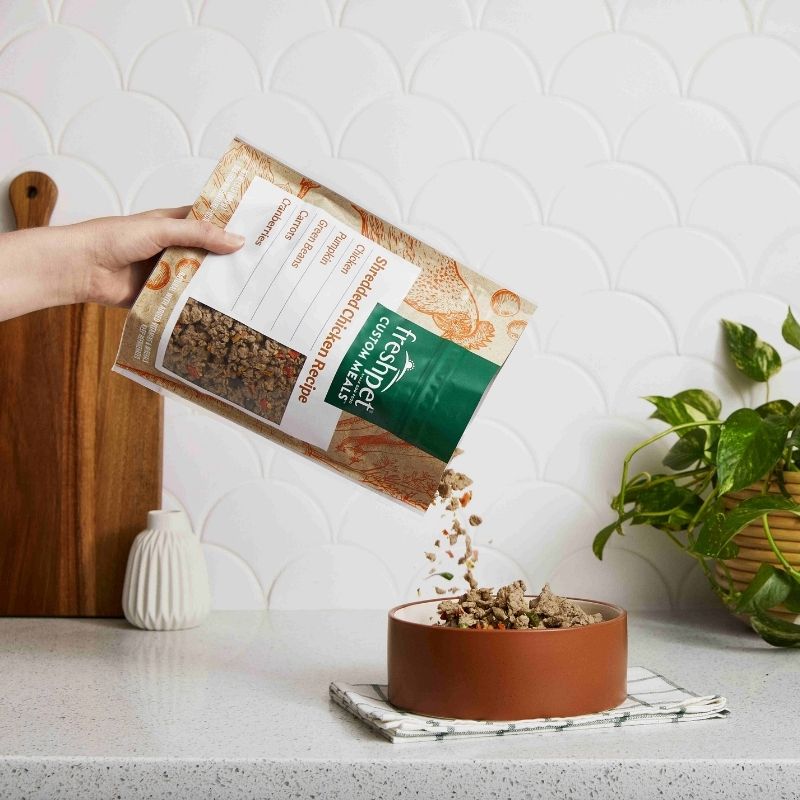
Thankfully, we’re in a much better place now. She’s eating dog food again, although kibble seems to have been permanently voted off the island. Freshpet Delivery custom meals are her absolute favorite right now, although she’ll also eat several other wet foods (depending on her mood).
Getting here taught me quite a bit, though. So rather than give you another generic list of tricks for getting a picky dog to eat, I want to share what actually helped us when illness and medication completely changed Freya’s appetite.
Quick note: Appetite loss can have many causes, including the underlying illness itself, medication side effects, nausea, pain, dental problems, and other medical issues. If your dog’s appetite suddenly changes, especially if they already have a health condition, talk to your veterinarian. This is simply our experience and what I learned from it.
Freshpet Delivery takes a familiar fresh dog food brand and turns it into a much more personalized service. Instead of figuring out portions yourself, you get a meal plan and feeding guidelines based on your dog, with fresh, gently cooked food delivered right to your door.
BEST PRICE GUARANTEED
SAVE 55% OFF YOUR FIRST ORDER WITH FRESHPETPPA55
First, “picky” and “no appetite” aren’t necessarily the same thing
This was probably the first thing I had to recalibrate in my own head. A picky dog may turn down kibble and then materialize beside you the second you open a package of cheese. That’s not exactly what I was dealing with.
There were times when Freya seemed like she wanted to eat but couldn’t quite convince herself to do it. She’d investigate food, maybe take half a bite, and walk away.
Other times, though, she’d reject her regular dog food but happily eat something else. That difference became useful.
If your dog refuses their regular food but eagerly eats something else, they don’t necessarily have zero appetite. Their appetite may be reduced, they may have developed a food aversion, or their preferences may have changed. Refusing even foods they normally find irresistible is a different situation and deserves more attention.
Instead of asking myself, “Did Freya eat her dog food today?” I started thinking more broadly. Did she want anything? That gave me a much better idea of where her appetite actually stood.
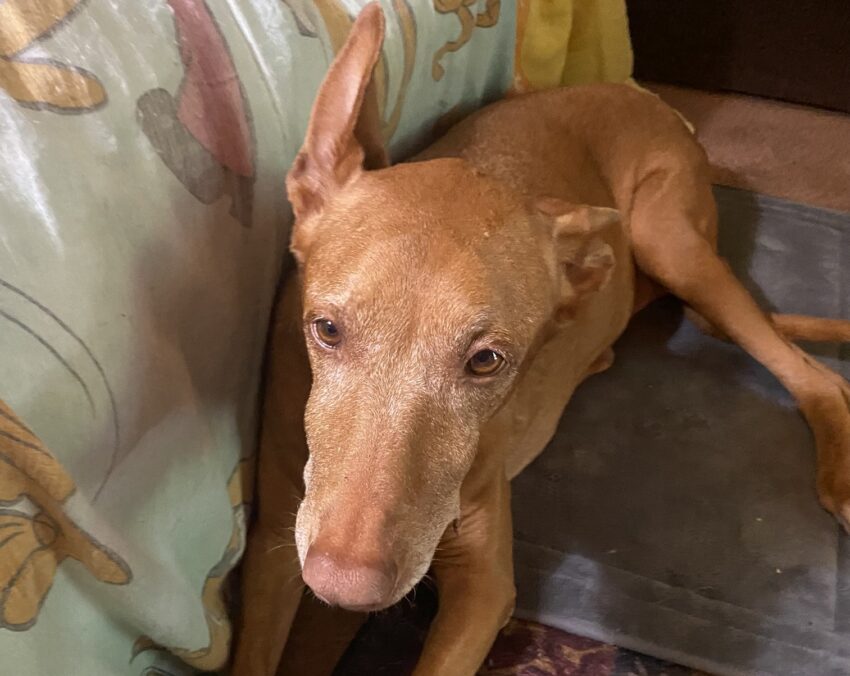
My vet gave me permission to stop worrying about the perfect diet
One of the most helpful things my vet told me was essentially, “Give her what she wants for now, and we’ll figure out her diet later.”
That was a huge relief for me and gave me the “out” I needed to stop obsessing so much.
When your dog has heart disease, it’s very easy to start analyzing every bite. Is there too much sodium? Is this nutritionally complete? Is that appropriate for a heart patient? How much fat is in it?
Those are all legitimate things to think about. But there’s also a point where the nutritionally perfect food isn’t doing your dog much good sitting untouched in a bowl.
We needed to get Freya eating first. That didn’t mean I suddenly decided turkey sausage was a nutritionally complete canine diet. It meant our priorities temporarily changed.
- First, get her interested in food.
- Then get some calories into her.
- Then work our way back toward complete dog food.
Once she was reliably eating again, we could worry about what her long-term diet should look like. And that’s pretty much what we did.
Obviously, this is something to discuss with your own vet. Different medical conditions come with different dietary considerations, and what’s okay as a temporary solution for one dog may be completely inappropriate for another.
But if your vet tells you to just get your dog eating for now, don’t feel guilty because dinner doesn’t look like the picture on the dog food bag.
Sometimes you have to deal with the problem directly in front of you before tackling the next one.
Don’t assume it’s necessarily the active ingredient in a medication causing upset stomach side effects
This is something I didn’t really think about until we went through it. Freya takes pimobendan for her heart. She initially took Vetmedin, and her appetite during that first stretch was awful.
During her second month of treatment, we switched to generic pimobendan. Her appetite improved quite a bit.
Now, before anyone runs with that, I absolutely cannot say that switching from Vetmedin to generic pimobendan is what brought her appetite back.
The timing muddies the waters considerably.
By that point, she’d been on heart medication for over a full month. Maybe she simply felt better because her treatment was working. Maybe her body had adjusted. Maybe her appetite would have improved at exactly the same time regardless of which version of pimobendan she was taking.
But there’s another possibility worth considering.
Medications aren’t made up solely of their active ingredient. Different formulations can contain different inactive ingredients, such as flavorings, fillers, binders, coatings, and other components.
Dogs can potentially tolerate one formulation differently from another.
That doesn’t mean you should switch your dog’s medication because they aren’t eating. Never change or discontinue a prescribed medication without talking to your veterinarian.
What it does mean is that it’s worth asking questions. If your dog develops appetite problems after starting medication, tell your vet. Ask whether another formulation, manufacturer, dosage form, or medication schedule could be an option.
Do not stock up on anything just because they ate it once
I cannot emphasize this one enough. When your dog hasn’t been eating and suddenly devours something, your first instinct is to think, FINALLY. WE FOUND THE FOOD.
Naturally, you go buy more. And naturally, your dog looks at it the next day as though you’ve offered her drywall.
Freya’s food preferences changed constantly during the worst part of this. She’d eat something enthusiastically one day and refuse it the next. Occasionally she’d come back around to it later. Sometimes that relationship was simply over. So I stopped assuming that one successful meal meant I’d discovered her new favorite food.
If you’re experimenting with different foods, buy individual cans, small packages, or the smallest quantity available until your dog has eaten it successfully several times.
You may not have found your dog’s new favorite food. You may have found Wednesday’s favorite food. There’s a difference.
How I served food sometimes mattered almost as much as what I served
There were times when Freya wouldn’t eat something from her bowl but would eat it from my hand. Or from a spoon. Yes, I spoon-fed my dog. No, I do not care if someone thinks that spoiled her. At that point, I wasn’t conducting a canine etiquette seminar. I was trying to get food into a dog who needed calories.
Smaller amounts also seemed less overwhelming than putting an entire meal in front of her.
If your dog is struggling to eat, you can ask your vet about trying things like:
- Offering smaller meals more frequently
- Hand-feeding
- Spoon-feeding soft foods
- Trying a plate instead of their usual bowl
- Warming wet food slightly to increase the smell
- Letting refrigerated food come closer to room temperature
- Offering food somewhere quiet and comfortable
You don’t have to get an entire day’s calories into your dog at breakfast. During the roughest stretches, I stopped thinking so much in terms of traditional meals. If Freya ate a little now and a little more two hours later, that still counted.
Try Changing the Bowl (Yes, Really)
This is one of those things that sounds almost too silly to mention, but changing Freya’s bowl actually seemed to make a difference.
During the worst of her appetite problems, she wouldn’t eat anything out of her metal bowl. I eventually bought her a bamboo bowl, and she started eating from it. Even now that her appetite is much better, she still won’t eat out of the metal bowl but happily eats from the bamboo one.
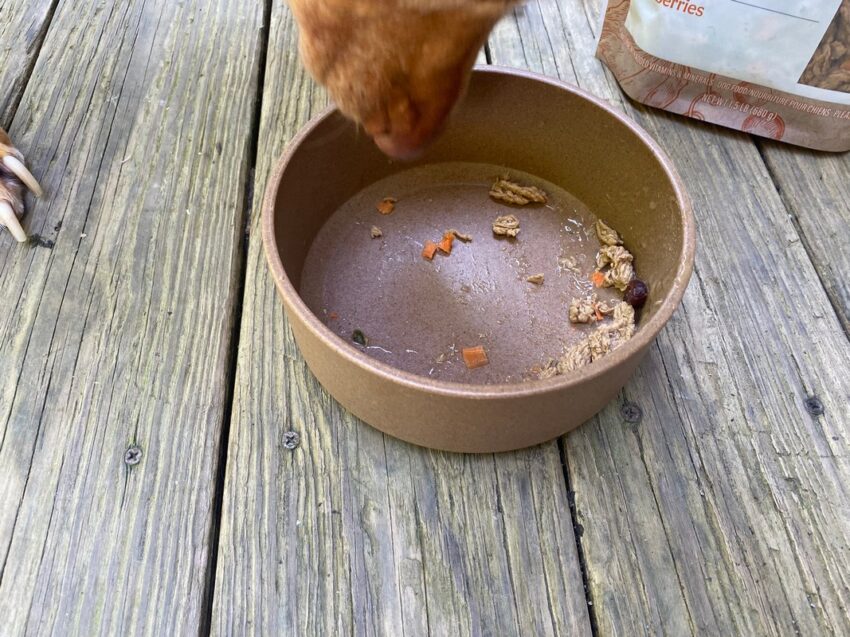
Do I think buying a different bowl will magically restore a sick dog’s appetite? Nope. There were way too many things happening at roughly the same time for me to give the bowl that much credit. We changed Freya’s pimobendan formulation around that period, and she was also about six weeks into treatment. She may simply have been reaching the point where she felt better.
But the fact that she still prefers the bamboo bowl tells me the bowl itself mattered to her for some reason.
Metal bowls can feel, sound, and smell different from other materials. Tags can clink against them, they can move around or make noise on the floor, and some dogs may simply develop a preference for another type of bowl. Freya can’t exactly tell me what her objection is. (I’ve asked. She’s being remarkably unhelpful.)
So, no, I wouldn’t put “buy a bamboo bowl” at the top of my list for a dog who’s stopped eating. But when you’re already working with your vet on the medical reasons behind a poor appetite, changing something as simple as the bowl is an easy, low-stakes thing to try.
This is the exact bowl that I got her (it’s actually a dish, but I call it a bowl). The medium-size option costs under $9 and is amazing. We bought a larger one just for her water, too.
Dolce Bamboo dogs and cat bowls were crafted using renewable and sustainable resources making them perfect for your pet supplies. It's the perfect choice for conscious pet owners that are looking for both stylish and environmentally responsible dog accessories.

A bunch of small successes can eventually equal a decent day
This helped me mentally as much as anything else. It’s very easy to put down a full bowl, watch your dog eat four bites, and think, She barely ate anything. But four bites aren’t nothing.
If she ate a little more later, took some food from my hand in the afternoon, ate half a serving at dinner, and wanted another small amount before bed, the day’s total could look considerably better than any individual “meal” suggested.
When appetite is really poor, it can help to keep a simple food log (see below for a really basic one). You don’t need an elaborate spreadsheet unless spreadsheets make you happy (I’m not judging).
Just jot down:
- What you offered
- Approximately how much your dog ate
- When they ate
- When medications were given
- Any vomiting, diarrhea, nausea, or other digestive symptoms
- Foods they were particularly interested in or refused
You may start noticing patterns. It also gives your vet much more useful information than trying to reconstruct three days of meals from memory while standing in an exam room.
Want an easy way to keep track?
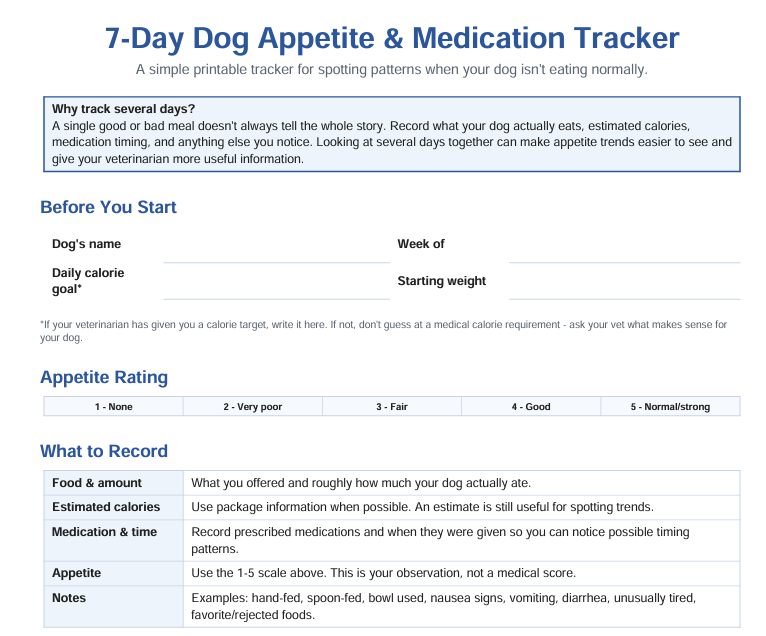
I made a simple (I’m not a designer) and free 7-Day Dog Appetite & Medication Tracker that lets you record what your dog eats, estimated calories, medication timing, appetite changes, weight, and anything else you notice. There’s also a weekly summary so you can look for patterns and have something useful to share with your vet.
Download the Free 7-Day Dog Appetite & Medication Tracker
Don’t turn every meal into a negotiation
This one took me a little longer. When your dog needs to eat, it’s incredibly tempting to hover. How about this? No? What about this? Chicken? Turkey? Would madam prefer something from the pâté menu?
Eventually, you’re stressed, the dog knows you’re stressed, and you’ve surrounded her with a buffet she didn’t ask for.
I learned to offer Freya food, try another reasonable option if she wasn’t interested, and sometimes just give her a little space.
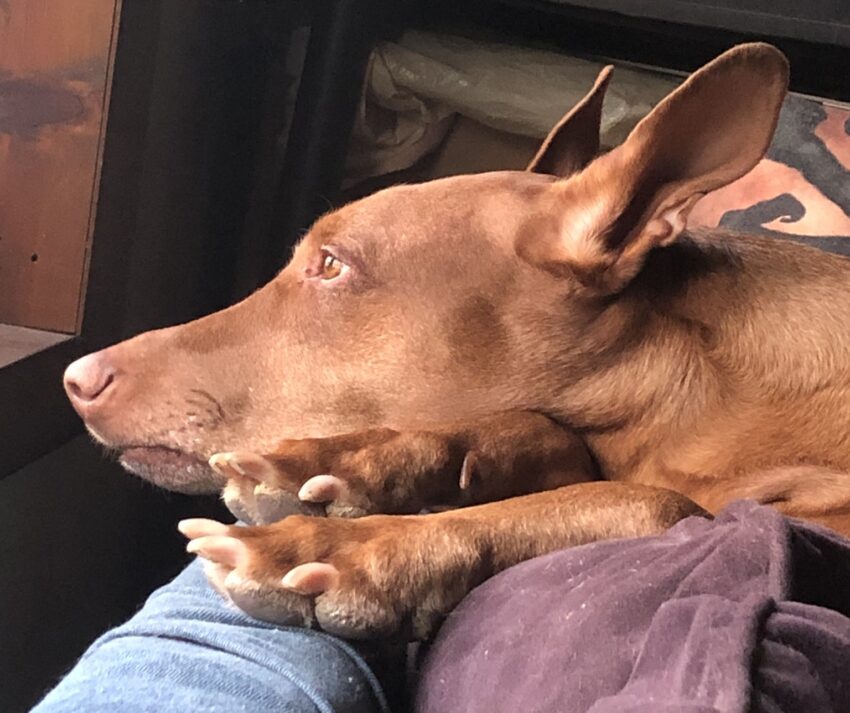
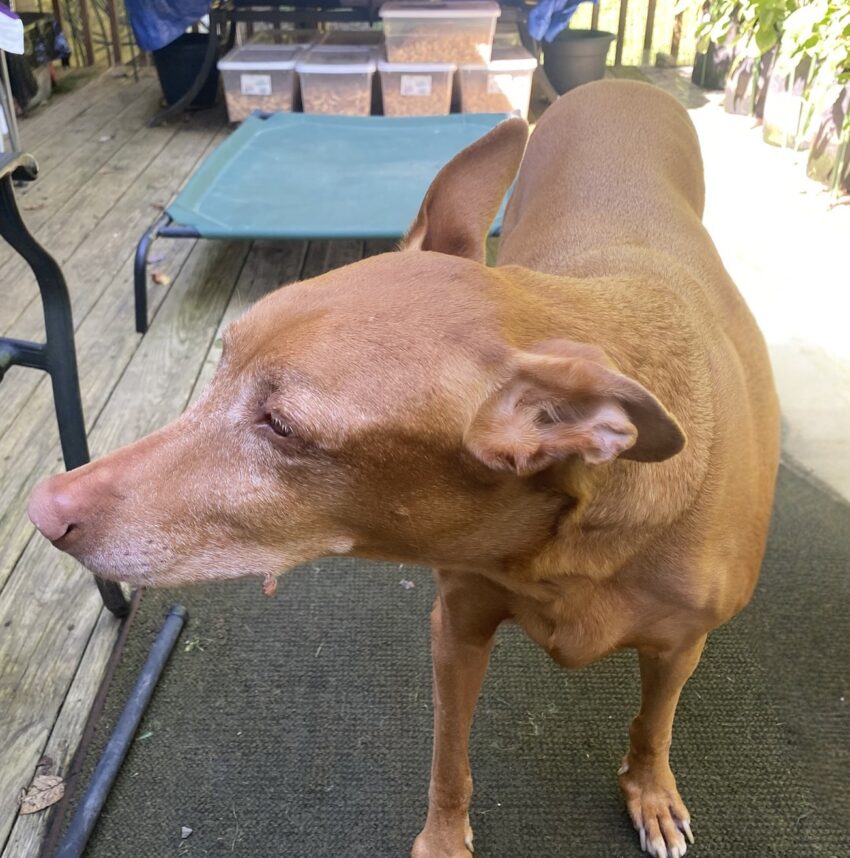
I wasn’t going to “out-stubborn” her. It’s impossible to do so anyway because she’s by far the most stubborn dog on the entire planet. Look. This is her stubborn face, aka “If I’m not looking at you, then you can’t prove I can hear you, so I don’t have to pay attention to what you’re saying or doing face.”
“People food” can be a bridge back to dog food
During Freya’s worst appetite stretches, there were days when the foods she’d reliably eat weren’t what I’d choose as her permanent diet. And that was okay because they weren’t intended to be permanent. They were a bridge.
For Freya, that sometimes meant things like turkey meatballs or sausage, pumpkin from a spoon, and other foods that happened to appeal to her when her normal food didn’t. Again, this is where your vet needs to be involved.
A food that’s reasonable for one dog may be a terrible choice for another, particularly with conditions such as pancreatitis, kidney disease, diabetes, food allergies, or heart disease. And some common human foods are outright toxic to dogs.
But there’s a difference between feeding an improvised diet forever and temporarily using vet-approved foods to keep a sick dog eating. Eventually, we worked our way back toward actual dog food. That was always the goal.
Their new normal may not look like their old diet
This was another thing I had to let go of. I kept thinking about getting Freya “back” to how she ate before all of this.
But why did her diet have to look exactly the same? She’s older now. She has heart disease. She takes daily medications. She’s been through a pretty major change in her health. Maybe her preferences changed, too. Today, Freya is eating dog food again, but she overwhelmingly prefers fresh and wet food.
Kibble? Apparently, we’re done with that chapter of our lives, which figures because I had JUST bought her a 22-lb bag of her usual kibble right before her heart disease diagnosis and it’s still sitting in my Vittle Vault not being eaten two months later. I’m not going to wage a campaign to convince her otherwise simply because she used to eat it.
The goal isn’t to recreate Freya’s old diet. It’s to find a nutritionally appropriate diet that this version of Freya will reliably eat. For her, softer, smellier, moisture-rich foods seem to be much more appealing now. For another dog, the winning texture or format may be completely different.
Appetite doesn’t always come back overnight
I think this is particularly important if you’re currently in the middle of this. Freya’s appetite didn’t suddenly switch back on, it improved gradually.
At first, progress might simply mean showing more interest when I prepared food. Then she might eat a little more. Then she’d eat without me hand-feeding every bite. Then she started accepting more dog foods.
Eventually, eating stopped feeling like a major event we had to negotiate several times a day.
If I had been waiting for the day when she suddenly ate exactly like she did before her heart problems started, I would have missed a lot of signs that things were actually getting better.
Look at the trend, not just one meal.
Tell your vet what “not eating” actually means
I’ve learned that saying “My dog isn’t eating” doesn’t necessarily give the vet the whole picture. There’s a huge difference between:
“She won’t eat anything.”
and:
“She won’t eat her dog food, but she’ll eat turkey.”
Or:
“She’ll eat from my hand but not her bowl.”
Or:
“She eats well earlier in the day but refuses food after her medication.”
Or:
“She’s eating about half of what she normally eats.”
Or, in our current case:
“She’ll happily eat fresh and wet dog food but refuses kibble.”
Those details matter A LOT. Not eating at all is a major issue. The others, though, were surprisingly lower on my vet’s concern-o-meter (even though they were high on my own). Tell your vet what your dog will eat, what they won’t eat, approximately how much they’re eating, and whether you’ve noticed any relationship between their appetite and medication timing.
Also mention things like vomiting, diarrhea, drooling, lip licking, unusual swallowing, lethargy, or weight loss.
Be careful about hiding medication in favorite foods
When your dog only has three foods on the approved list, you really don’t want to accidentally destroy one of them.
If you’re constantly hiding medication in a favorite food, there’s always the possibility that your dog starts associating that food with the medication. Suddenly, you’ve lost one of the few reliable things they’ll eat.
Ask your veterinarian or pharmacist how each medication needs to be given. Some medications need to be given with food, others should be given on an empty stomach, and some have very specific instructions.
Don’t change how you administer medication without checking first. But whenever possible, I think it’s worth protecting those few foods your dog absolutely loves.
When the menu is already limited, you don’t want to lose a bestseller. That’s how lean burgers ended up permanently off the menu, which sucked because my vet had just said “those burgers plus rice equals a pretty good meal, so go with that.”
Keep an eye on weight, not just what’s left in the bowl
Freya lost weight during all of this, so eventually the question wasn’t simply whether she was eating. We needed to know whether she was eating enough. That’s something your vet can help you evaluate based on your dog’s weight, body condition, muscle condition, medical needs, and overall health.
It’s another reason I found looking at the entire day more useful than obsessing over individual meals. One lousy breakfast doesn’t necessarily tell you much. A dog consistently eating substantially less than usual and steadily losing weight tells you considerably more.
Look at Calories Over Several Days, Not Just One
One of the things I eventually learned was that a single day’s calorie intake didn’t tell me nearly as much as I thought it did. Freya’s appetite could swing wildly from one day to the next. There were days when she ate a surprisingly decent amount, followed by days when we just barely managed to get enough calories into her to sustain basic function.
Looking at her intake over several days gave me a much better picture of how she was really doing. One surprisingly good day didn’t mean her appetite was back, just like one terrible day didn’t necessarily mean we were going backward. What mattered more was the overall trend. Was she averaging more calories this week than last week? Were the really low-calorie days becoming less frequent? Was she maintaining her weight, or at least slowing down the weight loss?
That also helped me stop obsessing quite so much over every individual meal. If she had a lousy Tuesday but ate significantly better on Monday and Wednesday, I could look at those three days together instead of treating Tuesday like a complete disaster.
Obviously, there are limits to that. If your dog stops eating altogether or your vet has given you a specific daily calorie goal because of their health, you don’t want to assume they can just “make it up tomorrow.” But when you’re dealing with a fluctuating appetite like Freya’s, the multi-day pattern can tell you a lot more than any single day’s calorie count.
What I’d do differently if we had to go through this again
I hope we never have to repeat the Great Freya Food Strike, but I definitely learned a few things from it.
- I’d stop worrying about the perfect diet sooner.
- I’d buy much smaller quantities when testing new foods.
- I’d keep better notes about what she ate and when she took her medication.
- I’d pay attention to medication formulations instead of looking only at the active ingredient.
- I’d tell the vet specifically what she would eat instead of simply saying she wasn’t eating.
- I’d hand-feed and spoon-feed without worrying that I was creating some terrible lifelong habit.
- I’d use temporary foods as a bridge without feeling like I was somehow failing because every bite wasn’t nutritionally perfect.
- And I would accept sooner that her diet after becoming sick might not look exactly like her diet before.
- Most importantly, I’d remember that appetite recovery doesn’t necessarily happen all at once.
Where we are now
Thankfully, Freya is doing so much better with food. I can put actual dog food in front of her now and reasonably expect that most of it will end up inside the dog rather than sitting untouched while she looks at me like I’m some sort of monster for wanting her to actually eat it.
I’ll take it.
She may never go back to eating the way she did before her heart disease and medications. At this point, I don’t really care if she does. I care that she’s eating enough, enjoying food again, and getting a diet that works for the dog she is now.
After spending over a month trying to figure out what on Earth a dog with almost no appetite might agree to eat and bawling my eyes out on the days that she refused almost everything, worried that she was going to starve, that feels like a pretty good place to be.
FAQs About Dogs Losing Their Appetite on Medication
Can medication cause a dog to lose their appetite?
Yes, decreased appetite can occur with some medications, although illness, nausea, pain, stress, and other medical problems can also cause dogs to eat less. If your dog’s appetite changes after starting a medication, let your veterinarian know rather than assuming the medication is definitely responsible.
Can inactive ingredients in dog medications matter?
Potentially. Medications with the same active ingredient can have different inactive ingredients, including flavorings, binders, fillers, and coatings. If your dog seems to tolerate one formulation differently from another, it’s worth discussing with your veterinarian or pharmacist. Don’t switch formulations on your own.
Should I hand-feed a dog who won’t eat?
If your veterinarian is comfortable with it, hand-feeding can be a useful temporary way to encourage a dog with a poor appetite to eat. I worried a lot less about creating “bad habits” once getting enough calories into Freya became the bigger priority.
Is wet food better for a dog with a poor appetite?
Not necessarily, but some dogs find wet or fresh foods more appealing because of their aroma, texture, and moisture content. Freya now strongly prefers both over kibble. The best option is a nutritionally appropriate food that your individual dog will reliably eat.
When should I call my vet if my dog isn’t eating?
Call your veterinarian if your dog suddenly stops eating, particularly if they have an existing medical condition, take prescription medications, are losing weight, refuse even favorite foods, or have other symptoms. Your vet can tell you how urgently your individual dog needs to be evaluated based on their health history and symptoms.