
If you’ve ever Googled what to do when a dog is choking, overheating, bleeding badly, or has eaten something they shouldn’t, you’ve probably noticed something rather alarming: everyone seems to have a different answer.
Some pet first aid advice comes from veterinarians. Some comes from recommendations that have been passed around for decades. Some appears to have been borrowed from human first aid and adapted for pets. And some seems to have originated on Pinterest sometime around 2012 and simply refuses to die.
Now, for the first time, there’s an actual evidence-based set of guidelines to refer to.
On August 25, 2026, the RECOVER Initiative published its 2026 First Aid Guidelines for Dogs and Cats, the first pet first aid guidelines developed using a systematic evidence-review and consensus process. The project produced 38 treatment recommendations covering emergencies including heatstroke, choking, burns, toxin ingestion, hypoglycemia, severe bleeding, respiratory distress, opioid exposure, and cardiac arrest.
That doesn’t mean researchers suddenly discovered 38 completely new ways to save a pet. In fact, some of the recommendations will sound pretty familiar. But others clarify, update, or outright contradict pet first aid advice that is still widely shared online. And that makes this a much bigger deal than it probably sounds.
TL;DR – What Pet Owners Should Know
- • What happened: RECOVER released the first evidence- and consensus-based first aid guidelines specifically for dogs and cats. “`
- • What they cover: Emergencies such as heatstroke, choking, severe bleeding, burns, toxin exposure, low blood sugar, breathing problems, and cardiac arrest.
- • What changed: Some commonly repeated advice has been clarified or updated, including when to induce vomiting, how to cool an overheated pet, what to do for choking, and when a tourniquet may be appropriate.
- • The big takeaway: First aid is meant to help during the time between recognizing an emergency and reaching veterinary care, not replace a veterinarian. “`
💡 Why this matters: Pet first aid advice online is all over the place. These guidelines finally give pet owners, trainers, first responders, and publishers a science-based reference for what to do first (and what not to do) in a real emergency.
First, What Does “Evidence-Based” Pet First Aid Actually Mean?
RECOVER stands for the Reassessment Campaign on Veterinary Resuscitation. If the name sounds vaguely familiar, that may be because the organization has previously developed evidence-based CPR guidelines for dogs and cats.
For the new first aid guidelines, researchers started with specific clinical questions, systematically searched the available research, evaluated the quality of that evidence, and used it to develop treatment recommendations.
Those draft recommendations were then opened to the international veterinary community for a four-week commenting period before the final guidelines were published.
In other words, this wasn’t a few veterinarians sitting around saying, “Well, this is what I’ve always told people to do.” There’s an actual methodology behind it.
There is one important catch, though. Veterinary first aid research is still surprisingly limited. Some recommendations are backed by moderate evidence, while others rely on very low-quality evidence or expert opinion because nobody has actually conducted the necessary studies in dogs and cats yet.
RECOVER is very transparent about that, which I actually appreciate. The guidelines don’t pretend we know things that we don’t. They also identify those research gaps so future studies can (hopefully) give us better answers.
What Counts as Pet First Aid?
The guidelines focus specifically on the prehospital period. Basically, something has happened to your dog or cat, and you’re not at the veterinary hospital yet.
First aid is what you can safely do during that gap to preserve life, prevent the situation from getting worse, and give your pet a better chance of reaching professional care.
It is not meant to replace veterinary treatment. In fact, one of the most consistent themes throughout the guidelines is some variation of:
Do this immediately, then get the animal to the nearest open veterinary facility.
The general RECOVER “Recognize and Act” algorithm ultimately directs virtually every genuine emergency to veterinary care.
That’s an important distinction because pet first aid advice online sometimes drifts dangerously close to “try this at home and see what happens.”
These guidelines aren’t about treating emergencies yourself. They’re about knowing what you can safely do while getting your pet to someone who can.
So, What Actually Changed?
The complete guidelines are extensive, and unless reading veterinary journal articles is your idea of a relaxing evening, you’re probably not going to sit down and work through all of them.
Here are some of the recommendations pet owners should know about.
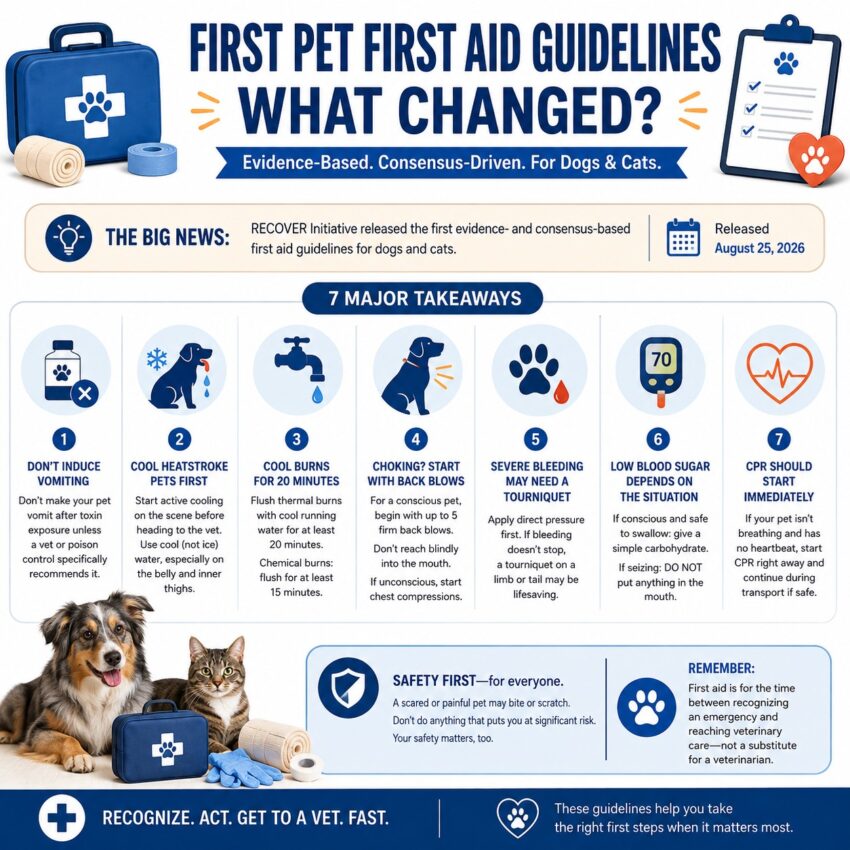
1. Don’t Automatically Make a Dog or Cat Vomit After They Eat Something Toxic
This is probably one of the most important changes for pet owners because “make them throw up” has been standard internet advice for years.
RECOVER now recommends against routinely giving an emetic to make dogs or cats vomit after toxin ingestion.
There are situations where inducing vomiting may still be appropriate, but the guidelines suggest doing so before reaching a veterinary hospital only when immediate veterinary care isn’t available and a veterinarian or animal poison control center specifically recommends it.
That’s a pretty important qualifier. Different substances create different risks. Something that was dangerous going down may cause even more damage coming back up, and inducing vomiting isn’t appropriate for every pet or every exposure.
So the new rule of thumb is much simpler:
Your pet ate something potentially toxic? Call your veterinarian, emergency vet, or animal poison control center before trying to make them vomit. The bottle of hydrogen peroxide doesn’t get to make this decision.
2. If Your Pet Is Overheating, Start Cooling Them Before You Leave for the Vet
There’s another piece of internet advice that often says not to spend time cooling an overheated dog because you should get them to the emergency vet immediately.
RECOVER’s guidelines make this more nuanced.
If a dog or cat is showing signs of heat-related illness, move them to a cooler environment, stop all activity, and begin active cooling on the scene before transport, as long as you can do so safely. The guidelines suggest using cool running water on the body, particularly areas with thinner hair such as the abdomen.
The reasoning comes down to something fairly intuitive: the longer the body remains dangerously hot, the more damage can occur.
And heatstroke isn’t limited to pets trapped in hot cars.
Dogs can develop exertional heatstroke while running, hiking, playing, walking, or working, even when the outdoor temperature doesn’t seem exceptionally hot. Warning signs can include constant panting, suddenly refusing to continue an activity, lying down unexpectedly, disorientation, stumbling, excessive drooling, vomiting, diarrhea, or collapse.
After initial cooling, the animal still needs veterinary care immediately.
Side note: Cooling gear, such as a Kurgo’s cooling vest, may be useful for helping dogs stay more comfortable during hot-weather activities, but that’s prevention, not heatstroke treatment. Once a dog shows signs of heat-related illness, follow the emergency cooling recommendations below.
This lightweight vest uses evaporative cooling to draw heat away from your dog’s body—just wet, wring, and wear. Designed for comfort and function, it features an athletic cut, reflective accents, and dual access to collars or harnesses. Adjustable, sun-reflective, and easy to clean, it’s a must-have for every warm-weather adventure.

3. Cool Burns With Running Water, and Keep Going Longer Than You Might Think
For a thermal burn, RECOVER recommends applying cool running tap water for at least 20 minutes, ideally as soon as possible and within three hours of the injury.
Cool is the key word here. Not ice water. If running water isn’t available, alternatives such as a cool water-soaked towel may be used.
The guidelines also make an interesting point about recognizing burns in pets. They aren’t always as obvious as you’d expect underneath all that fur.
Burns can come from hot pavement, heating pads, grooming dryers, hot liquids, fires, and other heat sources. Sometimes the fur may look relatively normal even though the skin underneath has been injured.
Chemical burns are a little different. For caustic chemicals on the skin, the guidelines recommend flushing with running water for at least 15 minutes, while also protecting yourself with appropriate gloves and other protective clothing when necessary.
Again, you’re not trying to finish treating the burn at home. You’re performing first aid before veterinary treatment.
4. Choking First Aid Starts With Back Blows
If a conscious dog or cat appears to be choking and you can safely help, RECOVER recommends beginning with up to five firm back blows over the back of the chest, to either side of the spine.
If that doesn’t dislodge the obstruction, other techniques such as positioning the head lower than the body, abdominal thrusts, or chest thrusts may be considered.
One thing you shouldn’t do? Reach blindly into the mouth trying to grab whatever is stuck.
That’s especially important with a conscious, frightened animal who is already struggling to breathe. Aside from the very real possibility of getting bitten, you could potentially push the object farther into the airway.
If the animal becomes unconscious, the recommendations change. RECOVER advises immediately starting chest compressions. After 30 compressions, you can look inside the mouth and remove an object if you can actually see it, but don’t perform a blind finger sweep.
Even if you successfully clear the obstruction and your pet seems fine afterward, they should still be evaluated by a veterinarian because choking and the maneuvers used to relieve it can cause complications.
If you do get to the point where you need to do the Heimlich maneuver, this video is really helpful:
5. Severe Bleeding May Actually Call for a Tourniquet
Tourniquets have traditionally come with a lot of warnings, and for good reason. Used incorrectly, they can cause serious injury.
But uncontrolled bleeding can kill an animal before they ever reach an emergency hospital.
RECOVER recommends starting with direct pressure for severe external bleeding.
If severe bleeding from a limb or tail doesn’t stop or improve significantly with pressure, however, the guidelines say a tourniquet may be lifesaving. They suggest tourniquet use for a conscious dog or cat with severe limb bleeding that isn’t responding to direct pressure and give it a stronger recommendation if the animal has become unconscious.
A tourniquet should only be used on a limb or tail, never around the head, neck, or torso.
RECOVER also notes that improvised tourniquets made from materials such as a scarf or necktie may help when applied correctly. Ideally, the material should be at least two inches wide.
This is one of those skills I’d much rather learn before I ever need it.
Trying to remember how to improvise a tourniquet while your dog is bleeding heavily is not an ideal time for a crash course.
6. Low Blood Sugar Depends on Whether Your Pet Is Conscious and Able to Safely Receive Food
The guidelines also address hypoglycemia, which is especially relevant for people with diabetic pets.
If low blood sugar is documented on a glucose monitor but the dog or cat isn’t showing symptoms, RECOVER recommends feeding a dietary carbohydrate such as pet food.
If hypoglycemia is suspected or documented and your pet is showing symptoms but isn’t actively seizing, the guidelines suggest applying a thick simple carbohydrate such as corn syrup or glucose syrup between the cheek and upper premolars, provided doing so won’t delay veterinary care and doesn’t put the caregiver at risk.
But if the animal is actively having a seizure, don’t put food, syrup, water, medication, or anything else into the mouth. That’s a strong recommendation.
7. CPR Should Start Immediately When a Pet Goes Into Cardiac Arrest
RECOVER recommends immediate bystander CPR for dogs and cats experiencing cardiopulmonary arrest outside a veterinary hospital, assuming the rescuer can do so safely.
Transport to the nearest open veterinary hospital should begin as soon as possible, with CPR continuing during transport when it can be performed without putting the people in the vehicle at risk.
This isn’t really a surprising recommendation, but it reinforces why learning pet CPR before an emergency happens matters.
Watching a three-minute video while your dog isn’t breathing is a spectacularly bad backup plan.
One of the Most Important Recommendations Has Nothing to Do With the Pet
There’s another theme running through the entire document that deserves more attention: your safety matters, too.
A dog or cat in severe pain, respiratory distress, panic, or neurological crisis may bite or scratch even if they’ve never shown aggression before.
RECOVER repeatedly recommends against performing first aid when doing so would put the caregiver at significant risk.
That’s not abandoning your pet.
It’s recognizing that turning one emergency patient into two isn’t going to help anybody.

Why These Guidelines Matter Even More as Pet Health Tech Gets Smarter
There’s another reason I think these guidelines are arriving at exactly the right time. We’re getting much better at detecting that something may be wrong with our pets.
Health trackers can monitor things like resting respiratory rate, heart rate, sleep, activity, and changes in behavior. Continuous glucose monitors can warn caregivers about abnormal blood sugar. Smart cameras can let us see what our pets are doing when we’re not home. Some devices can flag changes before we’d necessarily notice them ourselves.
That’s great. But detection is only half the equation. Imagine your dog’s health tracker suddenly alerts you that their respiratory rate is unusually high. Now what?
Or your diabetic cat’s glucose monitor sounds an alarm. Now what?
Or your camera catches your dog collapsing in the yard while you’re inside. Now what?
Pet technology can increasingly tell us, “Something isn’t right.” It can’t replace knowing what to do with that information.
That’s where evidence-based first aid guidance becomes incredibly valuable. The more health data we have access to, the more important it becomes to understand which changes require immediate action, what we can safely do ourselves, and when we need to stop Googling and start driving to the emergency vet.
The Guidelines Also Show How Much We Still Don’t Know
One of the things I like most about the RECOVER guidelines is that they don’t try to make the science sound more settled than it is.
The researchers openly identify some pretty substantial gaps.
For example, there aren’t studies comparing different choking techniques in dogs and cats. Researchers still don’t know the ideal way to adapt some methods for different animal sizes and body shapes. There also isn’t direct research showing whether tourniquets improve survival in dogs and cats with life-threatening limb bleeding.
That’s why you’ll see different evidence ratings throughout the guidelines.
A strong recommendation doesn’t necessarily mean there’s a mountain of dog-and-cat research behind it. In some cases, the available veterinary evidence is sparse, but experts concluded that the potential benefit so clearly outweighs the risk that a strong recommendation is still appropriate.
That’s an important bit of context when you see the words “evidence-based.”
It doesn’t mean scientists have tested every possible emergency intervention on thousands of pets.
It means they systematically looked at the best available evidence, evaluated its quality, incorporated expert consensus where evidence was lacking, and told us how confident they are in the result.
That’s a huge improvement over “someone on Facebook said their breeder told them to do this.”
What Pet Owners Should Do With This Information
You definitely don’t need to memorize all 38 recommendations. But this is a very good reason to revisit what you think you know about pet first aid.
If you have an old pet first aid book sitting on a shelf, check when it was published. If you’ve saved emergency tips from social media, verify them. And if you’re putting together a pet first aid kit, don’t stop at buying supplies. Learn how and when you’re actually supposed to use them.
I’d also strongly recommend learning pet CPR and basic first aid from a reputable program rather than assuming you’ll figure it out when something happens.
Because that’s really the biggest takeaway from these guidelines. First aid isn’t about becoming your dog’s veterinarian. It’s about knowing how to recognize a true emergency, knowing which actions can help during those critical minutes before veterinary care, and perhaps just as importantly, knowing which well-intentioned things not to do.
For the first time, we now have a systematic, evidence-based veterinary framework to help answer those questions.
Considering how much questionable pet first aid advice is still floating around the internet, it’s about time.
Read the Full 2026 RECOVER First Aid Guidelines
The complete guidelines and supporting evidence review were published in the Journal of Veterinary Emergency and Critical Care on August 25, 2026:
RECOVER Guidelines: First Aid for Dogs and Cats – Clinical Guidelines
RECOVER Guidelines: Evidence and Knowledge Gap Analysis With Treatment Recommendations
The RECOVER Initiative announcement and overview also gives a much more human-readable overview if you’d rather not spend your afternoon deciphering PICO questions and GRADE evidence tables. (I don’t blame you.)