Can Dogs Eat Chicken Meal? What It Really Means on a Dog Food Label

# DOGVILLS

By:

Nicole
Picture of Nicole

Nicole

Writer

Hi there! I’m Nicole, the editor-in-chief and one of the writers here at DogVills. I’ve been a dog owner for most of my adult life and a dog lover for much longer than that. I grew up with a wonderful German Shepherd named Jake, who I loved SO much that I named my son after him. When I’m not writing for DogVills or my own site, Pretty Opinionated, I love spending time with my teenager (when he actually lets me) and my Pharaoh Hound, Freya. I’m also an avid reader AND a total TV fanatic.

Fact checked by: Nicole Etolen

Updated On:

can dogs eat chicken meal

DogVills is your trusted resource for all things related to responsible dog ownership. With a clear mission to enrich the lives of both dogs and their owners, we combine passion and expertise to provide valuable insights, tips, and advice for a happier, healthier bond with your furry friend.

Table of Contents

TL;DR — Can Dogs Eat Chicken Meal?

  • ✔️ Yes, dogs can eat chicken meal: It’s a concentrated, dry form of chicken protein—not filler or mystery meat.
  • ✔️ Chicken meal vs. whole chicken: Chicken meal contains far more protein by weight because the moisture has already been removed.
  • ✔️ Label rules matter: Ingredients are listed by pre-cooked weight, which can make whole meats look more important than they really are.
  • ✔️ Quality varies by brand: “Chicken meal” can be high-quality or low-quality depending on sourcing and processing.

Bottom line: Chicken meal isn’t a red flag on its own. In well-made foods, it’s often a reliable, efficient protein source—just don’t judge it without looking at the full label.

Protein Density
Chicken meal delivers more usable protein per pound than fresh chicken.
Label Clarity
Named meals like “chicken meal” are more transparent than vague terms like “meat meal.”
Brand Trust
The best indicator of quality isn’t the ingredient—it’s the company behind it.

If you’ve ever flipped over a bag of dog food, scanned the ingredient list, and stopped cold at “chicken meal,” you’re not alone. That word meal has a reputation problem. It sounds… industrial. Vague. Like something that should come with a warning label.

But here’s the truth: chicken meal isn’t automatically bad—and in many cases, it’s actually a very solid protein source for dogs. The problem isn’t the ingredient itself. It’s the lack of context most labels give you.

So, let’s break it down in plain English. What chicken meal actually is, how it differs from whole chicken, what dog food labeling laws allow (and don’t), and how to tell whether the chicken meal in your dog’s food is something to trust—or something to side-eye.

What Is Chicken Meal, Exactly?

Chicken meal is made by rendering chicken—a process that removes moisture and fat, leaving behind a concentrated protein powder.

That’s it. No mystery goo required.

Legally speaking, chicken meal must come from clean chicken flesh and skin, and it may include bone. It does not include feathers, beaks, or feet (despite what the internet loves to claim).

The definition is set by Association of American Feed Control Officials, better known as AAFCO, which creates the ingredient standards most U.S. pet foods follow.

So, when you see chicken meal on a label, you’re looking at a dry, concentrated form of chicken protein—not leftovers scraped off a factory floor.

Chicken Meal vs. Whole Chicken: Which Is Better?

This is where things get interesting, because the answer isn’t as simple as “fresh is best.”

Whole Chicken on the Label

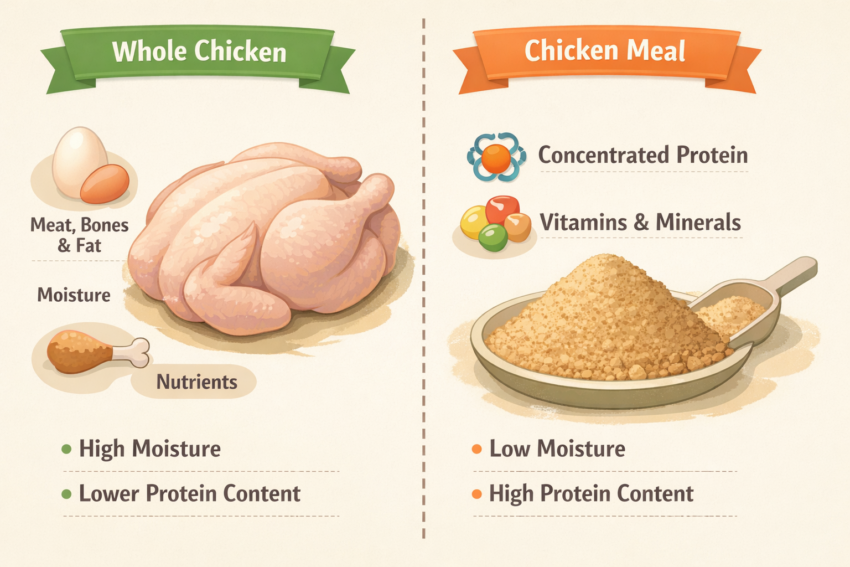
Whole chicken sounds great—and it is a quality ingredient—but it’s about 70% water by weight.

That matters because ingredients are listed by weight before cooking.

So a food that lists whole chicken as the first ingredient may look protein-rich, but once that water cooks off, the actual protein contribution drops significantly.

Chicken Meal on the Label

Chicken meal has already had the moisture removed, which means:

  • It’s far more protein-dense
  • It contributes more actual amino acids per pound
  • It stays nutritionally stable during cooking

In many cases, a food with chicken meal as the first ingredient can deliver more usable protein than one that relies heavily on fresh chicken alone.

This is why you’ll often see higher-protein kibbles using chicken meal strategically. It’s efficient, consistent, and easier to formulate balanced nutrition around.

 side-by-side view of chicken meal vs whole chicken

So Why Does Chicken Meal Get Such a Bad Reputation?

Mostly because of marketing—and fear-based assumptions.

Pet food marketing has trained us to associate:

  • “Fresh,” “whole,” and “real” = good
  • “Meal,” “by-product,” and “rendered” = bad

But nutrition doesn’t work that way.

The real issue isn’t meal vs. whole. It’s quality and sourcing—and that’s where labels can get murky.

What Dog Food Labeling Laws Actually Require

Here’s where things get less comforting.

Dog food labels in the U.S. are regulated at both the federal and state level, but not always in the way people assume.

The Food and Drug Administration (FDA) oversees pet food under federal law, mainly focusing on safety and preventing misleading claims. At the state level, most states enforce their own animal feed laws that are based on standards created by the Association of American Feed Control Officials (AAFCO). While AAFCO itself isn’t a government agency, its definitions and labeling rules are widely adopted and legally enforced by states.

What this means for dog food labels in practice:

  • Ingredient names must match AAFCO definitions. If a label says “chicken meal,” it has to meet AAFCO’s specific definition for that ingredient—not just whatever the manufacturer feels like calling it.
  • Ingredients are listed by weight before cooking or processing. Because whole meats contain a lot of water, they can appear higher on the ingredient list than their final protein contribution might suggest.
  • Nutritional claims must be accurate. Foods labeled as “complete and balanced” must meet AAFCO nutrient standards or pass feeding trials, and those claims are legally regulated.

What they don’t require:

  • Disclosure of ingredient sourcing
  • Transparency about rendering facilities
  • Clarification of ingredient grade (human-grade vs feed-grade)
  • Explanation of how many animals contributed to an ingredient

Basically, dog food labels aren’t the Wild West…but they don’t tell the whole story either. The rules set minimum standards for naming and nutrition, not transparency about sourcing or quality. Two foods can list “chicken meal” and mean very different things in terms of quality control, freshness, and sourcing standards.

How to Tell If Chicken Meal Is High Quality

Quick Guide: Is This Chicken Meal High Quality?

What to Check Why It Matters
Named source “Chicken meal” is more transparent than vague terms like “meat meal.”
Ingredient order Higher placement usually means it’s a main protein, not a filler.
Brand transparency Brands that explain sourcing and processing tend to be more trustworthy.
Protein levels Quality chicken meal should support appropriate protein percentages.
Dog’s response Good digestion, energy, and stools matter more than label language.

Bottom line: Chicken meal quality shows up in clarity, formulation, and how your dog does on the food—not just the ingredient name.

Since the label won’t tell you everything, you have to read between the lines a bit. Here’s what does help.

1. Named Protein Sources Matter

“Chicken meal” is specific—and that’s good.

Be cautious of vague terms like:

  • Poultry meal
  • Meat meal
  • Animal protein

Those give manufacturers much more wiggle room.

Named species = more accountability.

2. Where It Appears on the Ingredient List

Chicken meal listed first or second usually indicates it’s a primary protein source, not a filler.

If it’s buried after corn, wheat, or pea protein, it’s probably playing a smaller nutritional role.

3. Brand Transparency

Good brands don’t hide behind buzzwords. They explain:

  • Where their ingredients come from
  • How they’re processed
  • Why they chose certain formulations

If a company openly discusses rendering standards and protein sourcing, that’s usually a good sign.

4. Guaranteed Analysis vs. Ingredient List

The ingredient list tells you what is in the food.
The guaranteed analysis tells you how much nutrition your dog is actually getting.

A food with chicken meal should reflect that in:

  • Higher crude protein percentages
  • Balanced fat levels
  • Appropriate calorie density

If the protein is underwhelming, the meal probably isn’t pulling much weight.

Is Chicken Meal Safe for Dogs?

Yes—for the vast majority of dogs, chicken meal is safe, digestible, and nutritionally valuable.

That said, a few caveats:

  • Dogs with chicken allergies should avoid it (same as whole chicken)
  • Quality matters more for dogs with sensitive stomachs
  • Poor-quality meals can contribute to GI upset in some dogs

But the ingredient itself isn’t the villain. The formulation matters far more than whether the chicken arrived fresh or pre-dried.

If your pup is allergic, check out our list of chicken-free dog foods to try.

One More Thing: “By-Products” Are a Separate Conversation

Chicken meal and chicken by-products are not the same thing.

Chicken by-product meal can include organ meats, which are nutritionally valuable—but the term is broader and less precise.

That doesn’t automatically make by-products bad, but it does mean you should look harder at brand transparency if they’re used.

Chicken meal, by contrast, has a narrower legal definition, which is part of why it’s commonly used in higher-protein kibble formulas.

The Bottom Line

Chicken meal isn’t a red flag—it’s a tool.

Used well, it:

  • Provides concentrated, digestible protein
  • Supports muscle maintenance and energy
  • Helps create nutritionally complete dry foods

Used poorly, it:

  • Can mask low-quality sourcing
  • May rely on minimal oversight
  • Ends up doing less nutritionally than the label implies

So don’t judge the ingredient in isolation.

Judge:

  • The brand’s transparency
  • The full ingredient list
  • The guaranteed analysis
  • How your dog actually does on the food

Because at the end of the day, the best dog food isn’t the one with the prettiest label—it’s the one your dog thrives on.


Author

  • Hi there! I'm Nicole, the editor-in-chief and one of the writers here at DogVills. I've been a dog owner for most of my adult life and a dog lover for much longer than that. I grew up with a wonderful German Shepherd named Jake, who I loved SO much that I named my son after him. When I'm not writing for DogVills or my own site, Pretty Opinionated, I love spending time with my teenager (when he actually lets me) and my Pharaoh Hound, Freya. I'm also an avid reader AND a total TV fanatic.

    View all posts

Author

Picture of Nicole

Nicole

Writer

Hi there! I’m Nicole, the editor-in-chief and one of the writers here at DogVills. I’ve been a dog owner for most of my adult life and a dog lover for much longer than that. I grew up with a wonderful German Shepherd named Jake, who I loved SO much that I named my son after him. When I’m not writing for DogVills or my own site, Pretty Opinionated, I love spending time with my teenager (when he actually lets me) and my Pharaoh Hound, Freya. I’m also an avid reader AND a total TV fanatic.
Spread the love

You may also like.